
Compute at the orbital edge.
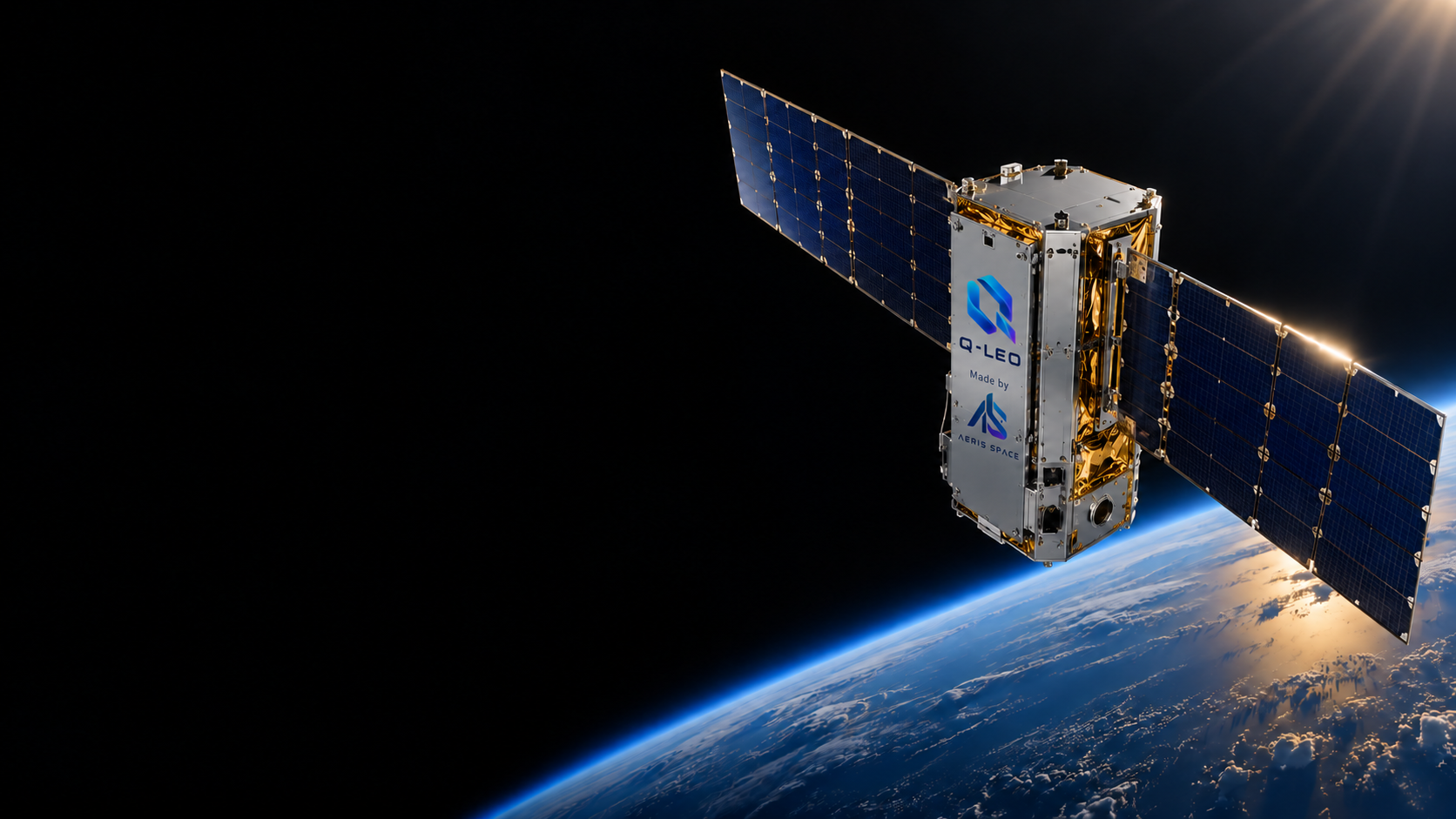
An experimental CubeSat architecture for advanced quantum–AI computing in space, connecting optical sensing, proposed onboard processing and communications. Explore the vehicle and its mission environment.
Explore Q-LEO
AERIS SPACE / QUANTUM AI FUSION
Quantum intelligence.
In orbital context.
DESIGN · SIMULATE · QUALIFY · OPERATE
MEET THE PRODUCT FAMILY
Q-LEO is designed to bring advanced quantum–AI computing into space. QxAMP connects observations with hybrid computation. Space C2 provides the context for quantum-enabled, AI-powered space domain awareness and research supporting spectrum superiority.
An experimental CubeSat architecture for advanced quantum–AI computing in space, connecting optical sensing, proposed onboard processing and communications. Explore the vehicle and its mission environment.
Explore Q-LEO
Quantum feature encoding, classical orchestration and hybrid algorithms meet in an editable research workbench. Follow the inputs, circuit choices and resulting probabilities.
Understand QxAMPStudy quantum-enabled, AI-powered space domain awareness using public orbital geometry and simulated Q-LEO assets. Follow object context, payload assumptions and processing evidence together.
Open Space C2THE MISSION INTENT
Research toward spectrum superiority connects spectral characterization, signal understanding and informed use of the electromagnetic environment. Q-LEO brings that objective into a shared architecture for sensing, hybrid computation and space domain awareness.
Research objectives · The workbench demonstrates models and simulations. Orbital quantum processing and operational spectrum superiority remain objectives requiring validation.
THE Q-LEO PRODUCT ARCHITECTURE
From the first photon to an orbital decision, explore the spacecraft, the computation and the environment together.
01 / LOW EARTH ORBIT
Place the Q-LEO design constellation in the same scene as public orbital traffic. Select a spacecraft, inspect its optical payload and move directly into mission access, digital assembly or quantum processing.
INSIDE THE SPACECRAFT
The R0.3 digital model connects payload, compute, power, thermal paths and deployment geometry. Open the spacecraft at component level, understand the allocation and run the existing analytical studies.
Select a subsystem: 01 Optical · 02 Compute · 03 Comms · 04 Power · 05 Thermal.
R0.3 / CONCEPTUAL LAYER DIAGRAMOptical collection, single-photon detection and event timing form the proposed sensing chain. QxAMP begins with the representation of those observations.
ENGINEERING SNAPSHOT
The public summary describes the candidate digital architecture. Expand a topic for its scope, then continue into the protected engineering workspace.
The R0.3 spacecraft model is a design candidate within the broader 6U / 12U architecture. The conceptual layer view explains subsystem relationships; detailed geometry and allocation live in the engineering workspace.
Inspect configuration ↗The current digital model allocates four compute nodes. QxAMP provides 13 research modules and an editable circuit workbench. An allocation describes a design choice, not a qualified flight processor or a measured in-orbit quantum result.
Explore the research modules ↗The architecture connects optical collection, single-photon event timing, feature encoding and proposed communications paths. Calibration, pointing, synchronization and link budgets remain explicit engineering questions.
Review the communications concept ↗Analytical studies explore selected assumptions and operating conditions. Flight qualification, radiation tolerance and an end-to-end orbital demonstration require separate evidence beyond a browser simulation.
Inspect engineering studies ↗A MISSION, EXPLAINED
Explore an educational Q-LEO-017 scenario. Change a synthetic feature and follow it through a reference circuit to an illustrative review record.
The value is dimensionless. It represents an example input, rather than a sensor measurement.
A synthetic optical feature gives this study a small, reproducible starting point. The spacecraft identity stays attached as the value moves through the example.
RESEARCH, WITH A WAY TO INSPECT IT
From transparent reference circuits to mission-level engineering, each research path makes its inputs, assumptions and evidence accessible.
Question How does one input change a reference quantum state?
Method Encode a synthetic value with a rotation and a controlled-X gate.
Evidence At x = 0.80, the exact model gives P(11) = 0.80. Reproduce the result and export its parameters.
Run the public example ↗Question Which representations help connect spectral observations with hybrid computation?
Method Inspect feature encoders, variational transforms, autoencoders and synthetic-data models.
Evidence The protected catalog exposes algorithm assumptions and reference workflows for study and comparison.
Explore algorithm research ↗Question How could onboard intelligence improve understanding of the orbital and spectral environment?
Method Bring spectral characterization, object context and traceable processing into mission studies.
Evidence path Compare calibrated observations, classical baselines and resource requirements before claiming operational advantage.
Read the research foundation ↗BUILD THE NEXT STUDY TOGETHER
Explore research collaboration, payload integration or a mission architecture study. Start with the objective, the available evidence and the questions the next experiment should answer.
Download the product brief Public overview · PDF · Research architecture and mission objectivesShare a research question, a comparison method or a candidate dataset.
Discuss a research study ↗02 / INTEGRATIONDiscuss interfaces, operating assumptions and an integration study.
Discuss payload integration ↗03 / MISSION ARCHITECTUREFrame an observation objective and the evidence needed to evaluate it.
Discuss a mission concept ↗